
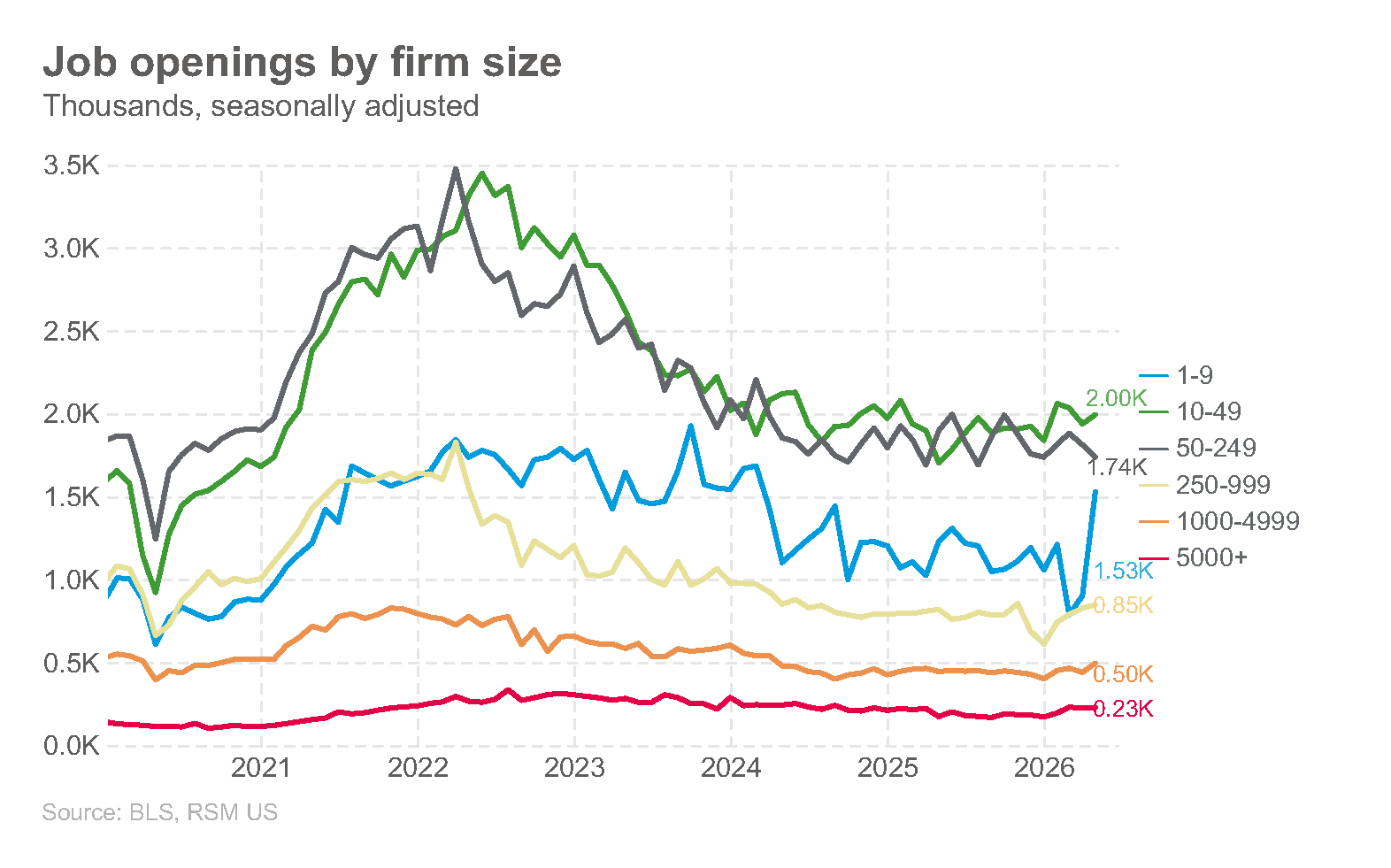
New data reaffirmed labor market improvement in April, with job openings climbing to the highest level since 2024.
The sharp increase in the Job Openings and Labor Turnover Survey from the Bureau of Labor Statistics followed disappointing results in February and March, which were most likely weighed down by severe weather and the sour mood around the start of the Iran war.
While this increase was an encouraging rebound, it looks more like a correction than the start of a new long-term hiring trend. One reason is that much of the increase came from small businesses with fewer than 10 employees, which tend to be more sensitive to weather disruptions.
Get RSM’s Market Minute commentary every morning. Subscribe now.

The data supports our call for another solid month of job gains in May, with 95,000 net payroll additions forecast ahead of Friday’s release.
That said, there are still plenty of headwinds for the labor market, so some caution is warranted.
Rising business sentiment has yet to translate into stronger hiring optimism, according to recent ISM manufacturing data.
We expect a similar signal from the ISM services report later this week.
While the AI buildout has been the single biggest factor propping up the economy in recent months, employment gains tied to AI remain limited outside construction. Other AI-related sectors have yet to see a meaningful pickup in hiring.
Our concern is that as inflation continues to erode, incomes and spending power, while energy supply remains constrained, demand destruction could arrive sooner than expected, putting heavier pressure on hiring over the next three months.
Inside the data
- Job openings jumped by 731,000 to 7.6 million, well above expectations and the highest level since mid-2024.
- Hiring moved the other way, falling by 419,000 to 5.1 million, a reminder that more openings do not always mean more jobs filled.
- Quits held steady at 3.0 million, suggesting workers are still cautious about leaving jobs.
- Layoffs stayed low at 1.7 million, pointing to a labor market that is slowing more through weaker hiring than broad job cuts.
- Most of the increase in openings came from professional and business services, while finance and insurance saw a decline.
- Small businesses saw a pickup in openings, supporting the view that weather-related distortions played a role in earlier weakness.