
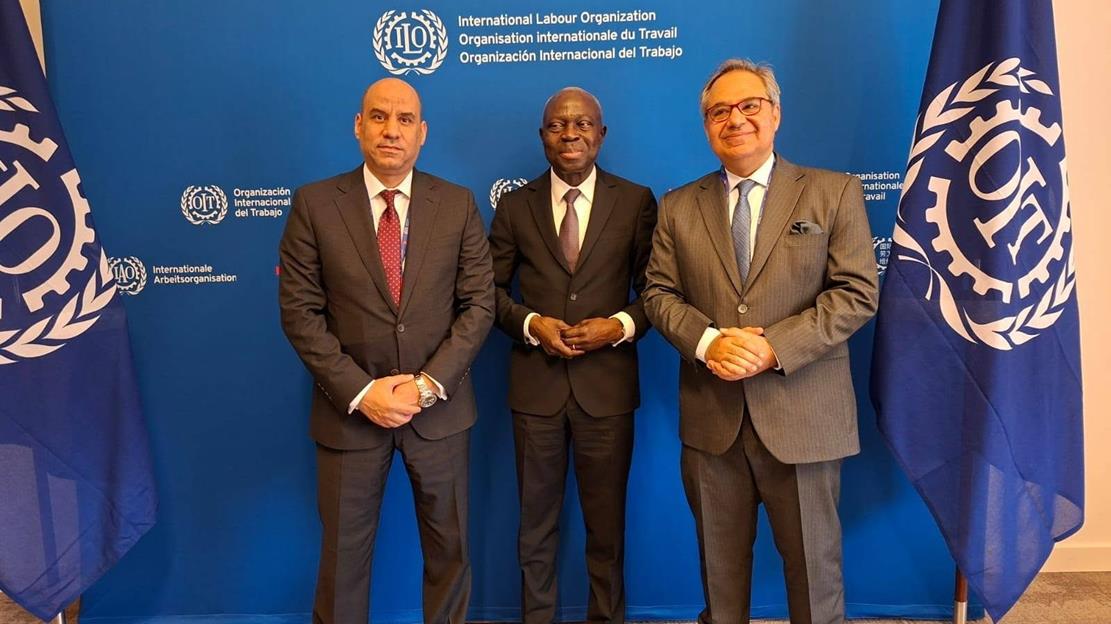
Minister of Labor Hassan Raddad on Saturday, June 06, 2026, discussed with Director General of the International Labor Organization (ILO) Gilbert F. Houngbo means of enhancing technical cooperation and joint coordination throughout the coming period, as well as a number of issues related to employment, decent work, social protection, and skills development.
The meeting, which took place on the sidelines of the 114th Session of the International Labor Conference in Geneva, was attended by Egypt’s Permanent Representative to the UN, the World Trade Organization and other international organizations Alaa Hegazy.
During the meeting, Raddad reviewed Egypt’s vision for developing the labor market, which is based on modernizing legislation, providing a safe and balanced work environment, strengthening social dialogue among production stakeholders, and expanding social protection and vocational training programs in line with rapidly evolving economic and technological changes.
The Minister affirmed that Egypt has made significant progress in recent years in aligning its national legislation with international labor standards, noting that the issuance of the new Labor Law represents a major milestone in the modernization of the labor system.
“The aforementioned law includes balanced guarantees that ensure stability in labor relations, protect workers’ rights, and support the investment and production climate at the same time,” the Minister said.
Raddad reviewed ongoing efforts to issue the domestic workers law, which is intended to regulate this important sector through a clear legal framework that defines the rights and obligations of all parties and is consistent with relevant international principles and standards. The proposed legislation is expected to enhance legal and social protection for domestic workers.
The meeting discussed progress achieved by Egypt in a number of areas of interest to the ILO, particularly the promotion of trade union freedoms, the consolidation of a culture of social dialogue, the expansion of social protection coverage, efforts to combat child labor, support for equality and non-discrimination in the workplace, and adaptation to new forms of work driven by digitalization and technological advancement.
The minister stressed that the state considers employment as one of the key pillars of economic and social development. He said this explains the strong government’s focus on implementing the National Employment Strategy, which serves as a comprehensive framework linking labor market needs with education, training, and skills development policies, in order to create productive and sustainable job opportunities, particularly for youth, women, and the most vulnerable groups.
MENA

Listen to the word paragraph