
Highlights: Canada Announces One-time TR to PR pathway for 33,000 Temporary Foreign Workers
- Canada launched a new TR-to-PR pathway for 33,000 foreign workers currently residing in the country.
- Canadian Immigration Minister Lena Metlege Diab made the official announcement on March 6, 2026.
- The TR to PR program was first announced in November 2025 and later confirmed by the federal government in the annual immigration levels plan.
- The one-time measure to offer permanent residence to temporary foreign workers will be processed in the next two years.
- The Canadian government is also planning additional measures to reduce the country’s temporary residence levels to less than 5% by 2027.
*Want to apply for Canada PR? Let Y-Axis guide you with the process.
Canada’s New TR-PR Pathway for Skilled Professionals
The Immigration Minister, Lena Metlege Diab, announced a new TR-to-PR pathway for skilled workers in shortage sectors. The one-time measure to offer permanent residence in Canada was initially announced in November 2025, followed by confirmation in the annual immigration levels plan by IRCC.
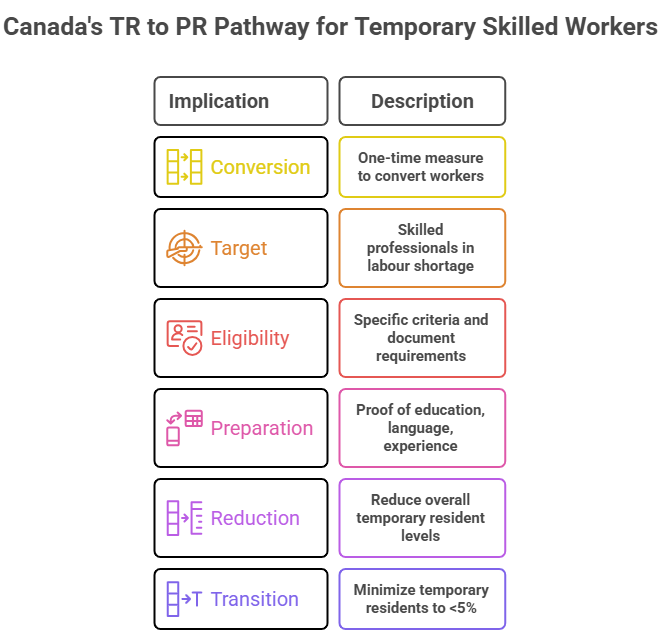
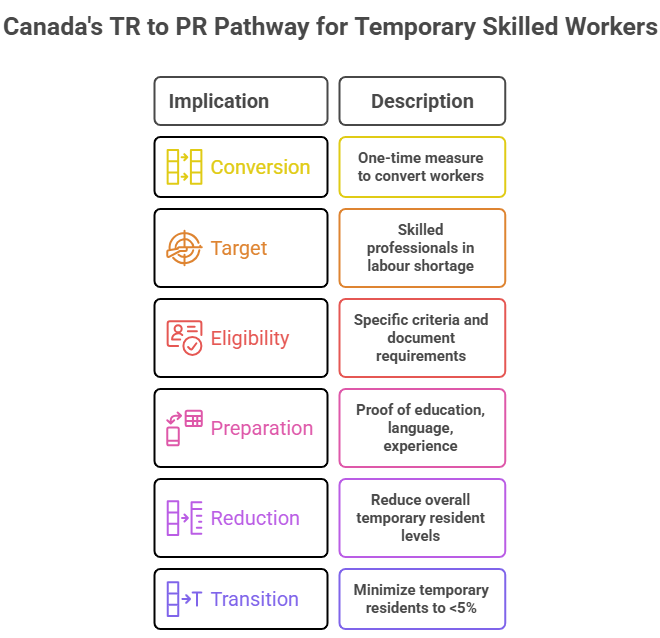
The TR to PR pathway has the following implications for temporary skilled workers in Canada:
- This is a one-time measure to convert more than 33,000 temporary foreign workers to permanent residence in Canada (PR).
- Canada’s new TR-PR pathway targets skilled professionals employed in labour-shortage sectors across rural areas.
- IRCC announced specific eligibility criteria and document requirements in the announcement made last Friday.
- Candidates interested in working in Canada on a permanent residence status must prepare their documents, such as proof of education, language proficiency, and work experience.
- The Canadian federal government has issued the new PR pathway to reduce overall temporary resident levels.
- The ongoing PR transition initiative aims to reduce the temporary resident population to less than 5% of Canada’s population by the end of 2027.
Also, read…
Top High-Paying Jobs in Canada That Support Fast-Track PR Pathways in 2026. Apply now!
Measures to Reduce Temporary Residence Level in Canada
The Canadian federal government has been issuing measures to reduce the overall level of temporary residents in Canada, including the transition of temporary workers to permanent residence. The government intends to reduce the temporary resident levels to less than 5% of Canada’s population by the end of 2027.
IRCC took the following measures to reduce the percentage of temporary residents in the country:
- In January 2024, the first annual cap on Canada study permit applications was introduced, restricting the number of curriculum licensing agreements for Post-Graduation Work permits (PGWPs).
- In September 2024, suspension of LMIAs( Labour market impact assessments) for the low-wage stream of the Temporary Foreign Worker Program (TFWP) in regions with high unemployment.
- In September 2024, the federal government also restricted the issuance of post-graduation work permits (PGWPs) and spousal open work permits (SOWPs).
- In October 2024, the first-ever targets for temporary resident admissions were set in the annual Immigration Levels Plan.
- Eligibility for PGWPs was revised, with minimum language proficiency requirements, from November 2024 onwards for graduates from in-demand sectors such as healthcare and skilled trades.
- In January 2025, SOWPs were granted only to spouses of international students enrolled in doctoral or master’s programs of at least 16 months.
- In the same month, SOWPs were issued only to spouses of foreign workers in the highest-skilled occupations (TEER 0 and 1) and to medium-skilled (TEER 2 and 3) workers from in-demand occupations such as healthcare, construction, and natural resources.
Canada’s initiative to reduce tempory residence in the country witnssed a significant result in 2025 and expects more postive outcomes with the newly announced TR to PR pathway.
*Are you looking for step-by-step assistance with Canada immigration? Contact Y-Axis, the world’s No. 1 overseas immigration consultancy.
For recent Canadian immigration updates, check out the Y-Axis Canada Immigration News Page.
FAQs
What is Canada’s new TR to PR pathway?
Canada’s new TR to PR pathway is an immigration program designed to help eligible temporary residents transition to permanent residency. It targets individuals already living in Canada on temporary status, such as foreign workers and international graduates, who contribute to the country’s labour market and economy. The pathway allows qualified applicants to apply for permanent residency without leaving Canada, provided they meet eligibility requirements such as work experience, education, and language proficiency. The program aims to retain skilled talent already integrated into Canadian society and help address labour shortages across key sectors.
Who can apply for Canada’s new TR to PR pathway?
The new TR to PR pathway is generally open to temporary residents who are already living and working in Canada. This may include international graduates, skilled workers, and individuals employed in sectors facing labour shortages. Applicants must typically hold valid temporary status, demonstrate relevant work experience in Canada, and meet language proficiency requirements. In many cases, candidates must also prove that they intend to continue working and settling in Canada. The pathway is designed to support those who are already contributing to Canada’s workforce and want to build a long-term future in the country.
Why did Canada introduce a new TR to PR pathway?
Canada introduced the new TR to PR pathway to retain skilled talent already living and working in the country. Many temporary residents, including international graduates and foreign workers, play an important role in Canada’s labour market and economic growth. By offering a structured route to permanent residency, the government aims to address labour shortages, strengthen the workforce, and support long-term population growth. The pathway also helps individuals who have already integrated into Canadian society transition more smoothly to permanent resident status, allowing them to continue contributing to the country’s economy.
What are the basic eligibility requirements for the TR to PR pathway?
Eligibility requirements for the TR to PR pathway usually include holding valid temporary resident status in Canada, having relevant work experience in the country, and meeting minimum language proficiency requirements. Applicants may also need to demonstrate that their work experience is in an eligible occupation and that they intend to settle in Canada permanently. In some cases, education credentials or graduation from a Canadian institution may also be required. Meeting health and security requirements is mandatory for all applicants. The exact criteria may vary depending on the specific stream under the pathway.
Does the TR to PR pathway require Canadian work experience?
Yes, Canadian work experience is often a key requirement for the TR to PR pathway. The program is designed to prioritize individuals who are already contributing to the Canadian labour market. Applicants may need to demonstrate a specific period of work experience in Canada within eligible occupations. This requirement ensures that candidates are familiar with the Canadian work environment and have already integrated into the workforce. By focusing on applicants with Canadian experience, the program helps retain workers who are already supporting the country’s economic growth and filling labour shortages.
Can international graduates in Canada apply for the TR to PR pathway?
Yes, international graduates from recognized Canadian institutions may be eligible to apply under certain streams of the TR to PR pathway. Graduates who have completed their studies in Canada and gained work experience through programs like the Post-Graduation Work Permit may qualify if they meet other eligibility criteria such as language requirements and employment in eligible occupations. Canada values international graduates because they already have Canadian education and cultural familiarity, making it easier for them to integrate into the workforce and contribute to the economy as permanent residents.
How is the TR to PR pathway different from Express Entry?
The TR to PR pathway differs from Express Entry because it specifically targets individuals who are already living and working in Canada on temporary status. While Express Entry is a points-based system that ranks candidates globally, the TR to PR pathway focuses on applicants who have Canadian work experience or education. This makes the process more accessible for temporary residents who have already built connections in Canada. The pathway is intended to complement existing immigration programs by providing an additional route to permanent residency for eligible workers and graduates.
What are the benefits of transitioning from TR to PR in Canada?
Transitioning from temporary residency to permanent residency offers several long-term benefits. Permanent residents can live and work anywhere in Canada without restrictions tied to an employer or visa conditions. They also gain access to public healthcare, social benefits, and educational opportunities at domestic tuition rates. PR holders can sponsor eligible family members and eventually apply for Canadian citizenship after meeting residency requirements. Moving from temporary status to permanent residency also provides greater stability and security, allowing individuals to build a long-term life and career in Canada.
How long does it take to process TR to PR applications?
Processing times for TR to PR applications can vary depending on the number of applications received and the complexity of individual cases. Immigration authorities typically review factors such as eligibility, work experience, language proficiency, and security checks before making a decision. Processing times may also depend on the specific stream or category under which the applicant applies. While exact timelines can differ, applicants should ensure that all documents are accurate and complete to avoid delays. Submitting a well-prepared application can help speed up the overall review process.
Can TR to PR applicants include family members in their application?
Yes, many TR to PR pathways allow applicants to include eligible family members such as spouses and dependent children in their permanent residency application. Family members may receive permanent resident status at the same time if they meet the required eligibility criteria. Applicants must provide supporting documents such as proof of relationship, identity documents, and medical or security clearances for accompanying family members. Including family members in the application allows them to live, study, and work in Canada together once the permanent residency application is approved.