
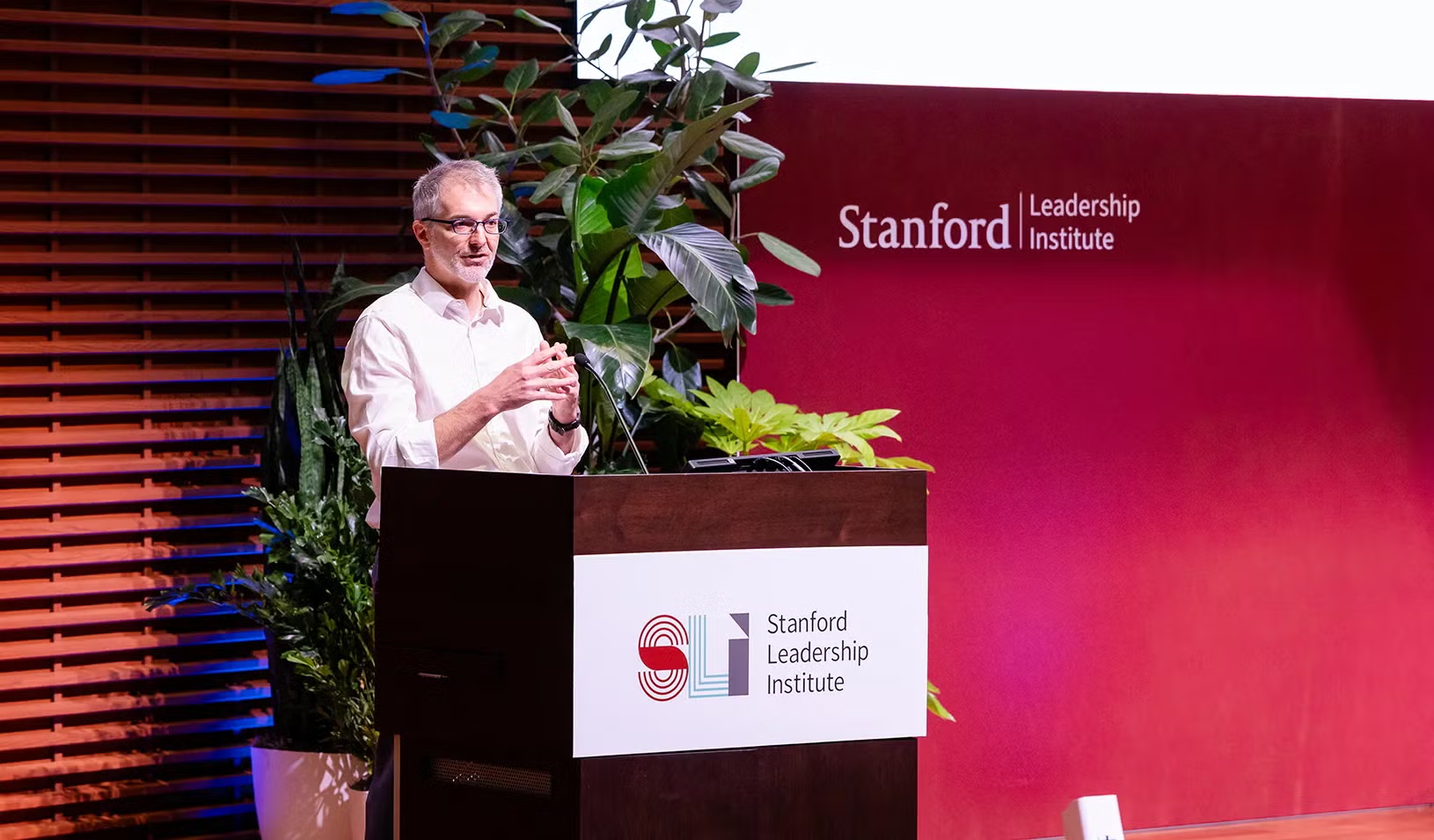
The leaders of tomorrow will need to navigate complex technological, geopolitical, economic, and environmental challenges in an uncertain world. At the 2026 Stanford Leadership Forum, dozens of leaders discussed how they have steered organizations through change and how to apply those lessons today.
The one-day event, held on April 15 at Stanford Graduate School of Business, celebrated the launch of the Stanford Leadership Institute (SLI), an interdisciplinary hub dedicated to advancing leadership excellence for a changing world. Based at Stanford GSB, the institute deploys innovative research, teaching, and convening to prepare leaders with insights and strategies to navigate and shape the dynamic forces impacting business and society.
“Leaders are not just people who react to external forces in society,” said Ken Shotts, the Vélez Reyes Faculty Director of SLI, as the event began. “They also have agency to shape how those forces impact their organizations and all of us in society.”
Global Perspectives
The forum included discussions on a range of topics, including financial literacy, U.S.-China strategic competition, and trust in American society. It opened with an international perspective as Sarah A. Soule, the Philip H. Knight Professor and Dean and Morgridge Professor of Organizational Behavior at Stanford GSB, spoke with Rishi Sunak, MBA ’06, former prime minister of the United Kingdom and the William C. Edwards Distinguished Visiting Fellow at the Hoover Institution.
Dean Sarah A. Soule in conversation with former Prime Minister Rishi Sunak | SF Photo
Sunak said the rules-based international order is gone. “The tricky thing is that we don’t know what has replaced it,” he said. “This geopolitical world that we’re living in, I think, genuinely is the most dangerous period of our adult lifetimes,” Sunak continued. “The paradox of the moment is that it’s at the same time the most transformational time that any of us have ever lived in.”
Discussing AI, Sunak noted the challenge of striking the right balance between letting market forces decide winners and enacting reasonable regulations. “I tend to come down on the side of the argument that says, we are too early in this for there to be very heavy top-down legislation of AI,” Sunak said. However, he added, “That doesn’t mean that I think we should do nothing. … [Y]our first duty always is the safety and security of your citizens.”
A discussion of geoeconomic power and economic security moderated by Matteo Maggiori, the Moghadam Family Professor of Finance at Stanford GSB, offered a historical perspective on current challenges. “If you look back at history, security policy, foreign policy, and economic policy have always been linked,” said Maurice Obstfeld, a senior fellow at the Peterson Institute for International Economics. “I don’t think we go back to the system we had. The question is: What kind of system can we construct?”
Former U.S. Secretary of State Condoleezza Rice, the Tad and Dianne Taube Director of the Hoover Institution and the Denning Professor in Global Business and the Economy at Stanford GSB, discussed the events — including the collapse of the Soviet Union and China’s admission into the World Trade Organization — that led up to the present moment. “As China evolved, it took the benefits of integration into that economy and began to challenge the American system,” Rice said.
H.R. McMaster, a retired lieutenant general in the U.S. Army and the Fouad and Michelle Ajami Senior Fellow at the Hoover Institution, noted that although opponents of the U.S., particularly China and Russia, might view increased polarization in the U.S. as a sign of weakness, they may also have overextended themselves. “I do see big vulnerabilities in each of these authoritarian regimes,” he said.
Facing the Unknown
Another recurring theme at the forum was how leaders deal with uncertainty.
In a conversation with Amit Seru, the Steven and Roberta Denning Professor of Finance at Stanford GSB, Ken Griffin, the founder and CEO of Citadel, discussed what effective leadership looks like when markets are volatile and politics are polarized. Griffin said business leaders must reject the “sunk cost fallacy” that paralyzes large corporations and instead have the agility to make decisions without clear information, pivoting rapidly when necessary. “Really successful businesses know when they need to change direction,” he said. “You only get there if you have an open and honest dialogue with one another about when you’re going in the wrong direction.”
Turning to technology, Griffin noted that a recent step-change in agentic AI has allowed Citadel to automate complex research workflows — tasks that previously required weeks of work by master’s and PhD graduates — in a matter of days. Griffin argued that rather than fearing job displacement, both businesses and the workforce become fundamentally more flexible in response to this technological shift. Effective modern leadership, he noted, means building a culture of continuous improvement that embraces these disruptions rather than retreating from them.
Professor Amit Seru and Citadel CEO Ken Griffin | SF Photo
A panel discussion on “Rewiring the Workforce” in the age of AI, moderated by Paul Oyer, the Mary and Rankine Van Anda Entrepreneurial Professor and Professor of Economics at Stanford GSB, focused on the likely impacts of new technologies.
Tamay Besiroglu, the CEO of Mechanize, which is working to automate knowledge work, said he thinks automation will advance gradually for the next five years or so, then accelerate. “I expect in the next one to three decades, we’ll probably have very widespread automation,” he said.
AI is already better than junior-level employees at many routine tasks, noted Susan Athey, PhD ’95, the Economics of Technology Professor at Stanford GSB. “There’s a lot of fear,” Athey said. “That’s something that also has huge political and geopolitical implications.” However, she noted that it’s easier to create a potentially transformational technology than to integrate that technology into an existing organization. “Now we’ve got 1,000 pieces of software, but nobody is getting better healthcare,” she said. “The organizational change is pretty profound that’s needed to fully take advantage of this.”